
The strong cow and calf bond broken: Behavioural and physiological stress responses to separation at varying times
4 June 2021
Introduction
Cows form strong bonds with their calves shortly after birth, which increases over time together. In nature the mother and young remain together for months or years, however commercial farming practices requires the pair are separated far sooner, particularly in the dairy industry. The premature breaking of the maternal bond when cow and calf are separated causes both distress, varying with how soon after birth the calf is removed from the mother. This essay examines bonding and maternal behaviour of cattle, farm practices, the effects of early separation and finally the evidence and conclusions in literature on when to separate for reduced distress. For clarification, the term early separation used throughout refers to any separation occurring prior to the natural order, delayed-early separation refers to separation over 24 hours after birth and expedited-early separation to separation either minutes or hours after birth.
Maternal behaviour and bonding
An extensive body of research confirms that cows and their calves form robust emotional bonds promptly after birth (von Keyserlingk and Weary, 2007) which are long lasting (Marino and Allen, 2017). The bond of mother and young has been defined as a ‘preferential mutual, emotional attachment, of relatively long duration, and that resists temporary separations’ (Newberry and Swanson, 2001 cited by Enriquez et al., 2011:28). Affiliative behaviours including licking, maintenance of closeness, care of body condition, protective behaviours and providing of food and heat, and are characteristic of the bond (Newberry and Swanson, 2008 and Lidfors and Jensen, 1988). Numerous physiological and psychological mechanisms produce behaviours that results in the seeking nurturing from it’s mother and the cow to engage appropriately with her calf (Enriquez et al., 2011). Hormones and neurochemicals, including oxytocin, prolactin and vasopressin, are also at play in initiating and sustaining the bond (Nelson and Panksepp, 1988). On an evolutionary basis the young calf is dependent on the bond for survival (Enriquez et al., 2011). Cows exhibit consistently strong maternal protective behaviour towards their calves (Pérez-Torres et al., 2014). Flörcke et al. (2012) investigated this behaviour by observing cows’ reactions when an approaching unknown vehicle approached mother and calf. They found that 99% of cows moved to put themselves between the vehicle and their calves in a protective manner.
Weaning and separation: natural and commercial farm conditions
The time immediately prior to birthing is one of the few instances when the cow withdraws from the herd, in order to have partial isolation with her calf during the peak sensitive time for establishing the cow-calf bond (Lidfors et al., 1994). After birth the cow licks the calf which establishes bonding and the newborn calf shows recognition of and interest in it’s mother within minutes of life (Enriquez et al., 2011). Under natural conditions cattle weaning takes place between 7 to 14 months after birth (Reinhardt and Reinhardt, 1981). Weaning occurs gradually with a decrease in milk supply and increase in intake of solid food by the calf (Martin, 1984). Trivers (1974) suggests there are three progressive stages: after birth the cow initiates contact, thereafter the calf initiates nursing, and in time the cow will begin rejecting sucking attempts to stop sucking permanently. Reinhardt and Reinhardt (1981) reports that calves retain some ‘closeness’ with their mothers for several months after sucking ceases. The male calves will leave the herd in time, however female calves stay in the herd where they have lasting matriarchal bonds (Kilgour & Dalton, 1984 cited in Flower and Weary, 2003).
In contrast to natural conditions, cows and their young in the farming industry, whether kept for beef or dairy, have vastly different experiences. On commercial dairy farms the separation occurs far earlier and more abruptly, either within a few hours (Le Neindre and Sourd, 1984) or days (Passille et al., 2008). The lactating cow is returned to the herd without her young to be milked for commercial purposes while calves are kept either in isolation or with other calves and artificially reared (Broom and Leaver 1978; Webster 1994). Cattle kept for beef are commonly abruptly separated at around 6 months after birth (Enriquez et al., 2011). Producers site a number of reasons for separating calves early. Economically dairy farmers stand to retain more milk to sell if the calf sucks less (Flower and Weary 2003), which is ultimately why cows kept for dairy are impregnated and calves born: to induce lactation. Commercial productively of the cow increases with early separation as sucking inhibits the animal’s return to oestrus, which is desired (Laster et al., 1973).
Behaviour and stress response to early separation
The behaviour, stress responses and long term effects of early separation have been researched and measured by numerous studies, as described as follows. Cows exhibit vocalisation and contact calls (Johnsen et al., 2015; Hudson and Mullord, 1977; Lidfors, 1996; Flower and Weary, 2001; Weary and Chua, 2000), searching behaviours (Panksepp, 1998 cited by Johnsen et al., 2015), alert behaviour, increased activity and restlessness (Johnsen et al., 2015; Hudson and Mullord, 1977; Lidfors, 1996; Flower and Weary, 2001), increased eye white percentage which is a meaningful measure of behavioural signs of frustration and emotion (Sandem and Braastad, 2005), remaining close to the separation barrier (Johnsen et al., 2015) and decreased rumination (Lidfors, 1996). Calves respond to separation with vocalisations, thought to evoke maternal care, relaying the need to reunite with the dam and is seen as a sign of frustration and distress (Johnsen et al., 2015; Weary et al., 2008; Newberry and Swanson, 2008; Enriquez et al., 2010; Weary and Fraser, 1995; Watts and Stookey, 2000; Latham and Mason, 2008; Flower and Weary, 2001), searching behaviours (Panksepp, 1998 cited in Johnsen et al., 2015), pacing which is interpreted as motivation to reunite with cow (Price et al., 2003; Enriquez et al., 2010; Ungerfeld, et al., 2009; Solano et al., 2007; Latham and Mason, 2008), increased activity (Lay et al., 1998; Weary and Chua, 2000; Loberg et al., 2008), and sucking behaviour directed at the pen or pen mates due to lack of access to the cow’s udder (Wiepkema, 1985; Rushen and De Passillé, 1995; Day and Webster, 1999). Calves experience negative emotional states due to separation which appears to influence judgment abilities in dairy calves. In a cognitive bias study Daros et al. (2014) tested the dairy calves, induced distress in them by separation from their mothers, then retested. The results suggest that calves, like humans, exhibit negative response bias when in a negative emotional state. Abrupt weaning has also been observed to cause physiological responses indicating stress, including an increase in plasma cortisol (Lay et al., 1988 and Loberg et al., 2008) and increase in plasma norepinephrine (Hickey et al., 2003). Lefcourt and Elsasser (1995) reported increased catecholamine with separation which decreases when the calf is reunited with its mother. A rise in heart rate also occurs after separation (Loberg et al. 2008). As well as the effects seen shortly after early separation there are long term consequences for the calf. The early maternal and social deprivation can affect calf health, welfare and behaviour including development of stereotypical behaviour, less social behaviour and skills, lower social status within the herd and exhibiting more fearful responses to unfamiliar animals than mother-raised calves (Warnick et al 1977; Le Neindre and Sourd 1984; Arave et al., 1992; Krohn et al., 1999; Wagner et al., 2013; Broom, 1978).
Evidence from vast numbers of studies and reviews concludes that cows and calves both experience distress and have detrimental effects following premature separation (Marino and Allen, 2017 and Enriquez et al., 2011), which alleviates when the pair are reunited (Solano et al., 2007). Johnsen et al. (2015) summarises as follows.
‘Premature breaking of the maternal bond between a cow and her calf triggers a strong behavioural response which renders separation and weaning major welfare challenges’. (Johnsen et al., 2015:11).
Indeed, The Farm Animal Welfare Council (FAWC) and a number of animal welfare organisations including Compassion in World Farming (CIWF) have raised welfare concerns regarding early separation on the grounds that it inhibits a number of normal behaviours and causes distress (CIWF, 2013; Webster et al., 1985; Webster, 1994; Flower and Weary, 2003).
Early separation: when to separate
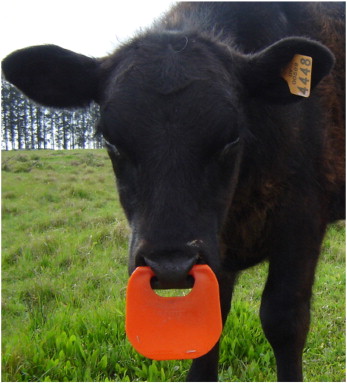
Research has been conducted to identify the effects of when (how long after birth) early separation affects cow and calf, many investigations with the aim of identifying separation timeframes that reduce distress while being compatible with commercial farming. The time mother and young are allowed together prior to separation varies between studies and industry use. Beef industry cattle remain together for months, though it is common for ‘nose plates’ (see figure one) to be fitted to prevent sucking, which causes the calf frustration (Enriquez et al., 2011). In dairy farming separation is exceptionally early, either expedited-early (minutes or hours) or delayed-early separation (one day to a few weeks post-birth). Many farmers state expedited-early is more compassionate, as well as economical, claiming there is less stress as the bond between the pair is less established (Flower and Weary, 2003).
Flower and Weary (2001) divided cow-calf pairs into two groups, separating them at either two weeks or one day. They found greater vocal and behavioural responses from both mothers and young separated after the two weeks (Marino and Allen, 2017). Numerous other studies likewise found that increased time together correlates with increased responses, for example Weary and Chua (2000) considered separation effects at 6 hours, 1 day and 4 days after birth, finding that calves removed after 4 days had higher call rates (Flower and Weary, 2003). Lidfors (1996) compared separation immediately or 4 days after birth and reported that removal at 4 days caused increase vocalisation activity.
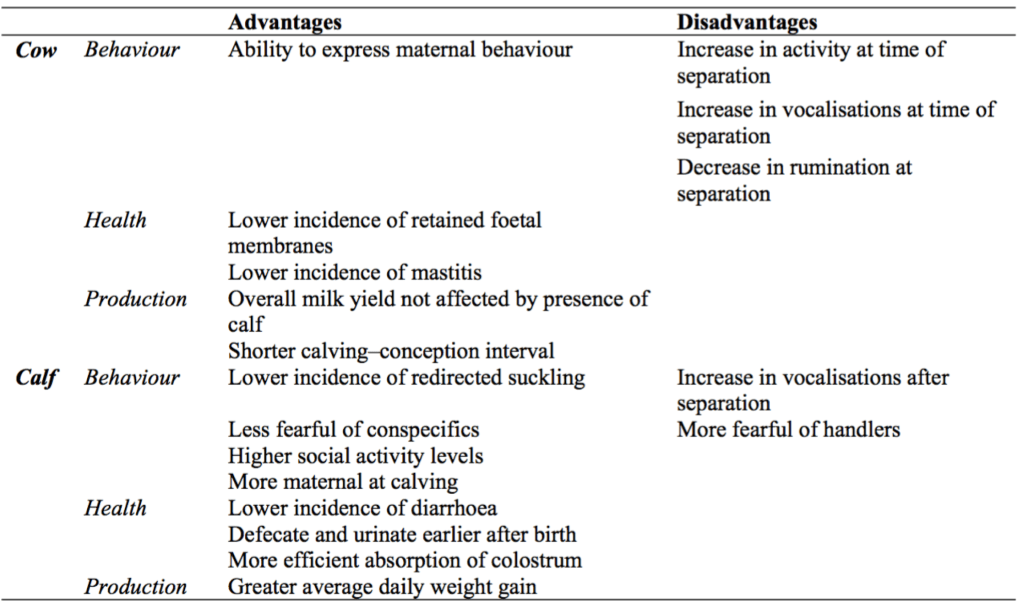
While many studies found decreased distress following expedited-early separation compared to delayed-early separation there are other factors to consider. Firstly, research shows there are other effects and concerns involved after expedited-early separation. Expedited-early separation can produce more issues with long term health, fearfulness, social behaviour and maternal behaviour, Flower and Weary (2003) found when reviewing relevant studies. In fact, Flower and Weary (2001) concluded that although delayed-early separation has a higher stress response the advantages of keeping the cow and calf together for longer may outweigh the increased separation distress (Flower and Weary, 2001). Flower and Weary (2003) summarised advantages and disadvantages, see figure two.
Countering the stance that expedited-early separation shows minimal distress, research by Hudson and Mullord (1977) shows that a strong maternal bond can form from as few as five minutes directly after birth. Cows separated from calves at this time showed signs of distress including continual vocalisation and restlessness. Despite the short bonding period they were capable of recognising their calves and exhibited maternal behaviour when reunited after 12 hours separated (Hudson and Mullord, 1977). This is significant.
As well as these factors, it is important to note that the discussions and conclusions from much of the research considers which protocol produces less distress. Both expedited-early separation and delayed-early separation cause stress and behavioural issues resulting in legitimate animal welfare concerns, voiced by animal welfare organisations. Ultimately, whether separation occurs expedited-early or delayed-early separation causes considerable animal welfare challenges (Flower and Weary, 2001). Whenever separation is done there will be effects on welfare (Flower and Weary, 2003), which is logical given the complexity and strength of the both cow and calf’s bond and need to remain together, inbuilt to ensure survival of the species. At this point an increased understanding of the natural weaning process, effects of the artificial breaking of the mother and calf bond, what mechanisms cause separation distress behaviours are needed (Enriquez et al., 2011).
Conclusion Cows and calves have a strong mother-young bonds shortly after birth. Although designed to stay together for months or longer, commercial farming requires they are separated, to the determent of both. Stress behaviour and physiological measures are observed following separation. A body of research attempts to ascertain when, either hours, days or weeks after birth, the cow and calf can be separated with minimal distress. However, the complex natural of cattle behaviour, the strong maternal cow-calf bond and the many separation responses and effects means premature separation of mother and young, at any time, is a welfare concern.
References
Arave, C., Albright, J., Armstrong, D., Foster, W. and Larson, L. (1992) Effects of isolation of calves on growth, behavior, and first lactation milk yield of Holstein cows. Journal of Dairy Science, 75, 3408- 3415.
Broom, D. and Leaver, J. (1978) Effects of group-rearing or partial isolation on later social behaviour of calves. Animal Behaviour, 26, 1255-1263.
Compassion in World Farming (CIWF) (2013). Dairy Cow-Calf Separation and Natural Weaning. Available at: https://www.compassioninfoodbusiness.com/resources/dairy/cow-calf-separation-and-natural-weaning/ [Accessed 4 April 2021].
Daros, R. R., Costa, J. H., von Keyserlingk, M. A., Hötzel, M. J. and Weary, D. M. (2014). Separation from the dam causes negative judgement bias in dairy calves. PLoS One, 9, e98429. Available at: https://journals.plos.org/plosone/article?id=10.1371/journal.pone.0098429 [Accessed 3 April 2021].
Day, J. and Webster, S. (1999) The effects of early weaning. Biologist, 46, 177-180.
Enriquez, D., Hotzel, M. and Ungerfeld, R. (2011). Minimising the stress of weaning of beef calves: A review. Acta Veterinaria Scandinavica, 53, 28.
Enríquez, D. H., Ungerfeld, R., Quintans, G., Guidoni, A. L. and Hötzel, M. J. (2010) The effects of alternative weaning methods on behaviour in beef calves. Livestock Science, 128, 20-27.
Flörcke, C., Engle, T. E., Grandin, T. and Deesing, M. J. (2012) Individual differences in calf defense patterns in Red Angus beef cows. Applied Animal Behaviour Science, 139, 203-208.
Flower, F. C. and Weary, D. M. (2001) Effects of early separation on the dairy cow and calf: 2. Separation at 1 day and 2 weeks after birth. Applied Animal Behaviour Science, 70, 275-284.
Flower, F. C. and Weary, D. M. (2003) The effects of early separation on the dairy cow and calf. Animal Welfare, 12, 339-348.
Hickey, M. C., Drennan, M. and Earley, B. (2003) The effect of abrupt weaning of suckler calves on the plasma concentrations of cortisol, catecholamines, leukocytes, acute-phase proteins and in vitro interferon-gamma production. Journal of Animal Science, 81, 2847-2855.
Hudson, S. and Mullord, M. (1977) Investigations of maternal bonding in dairy cattle. Applied Animal Behaviour Science, 3, 271-276.
Johnsen, J. F., Ellingsen, K., Grøndahl, A. M., Bøe, K. E., Lidfors, L. and Mejdell, C. M. (2015) The effect of physical contact between dairy cows and calves during separation on their post-separation behavioural response. Applied Animal Behaviour Science, 166, 11–19.
Krohn, C., Foldager, J. and Mogensen, L. (1999) Long-term effect of colostrum feeding methods on behaviour in female dairy calves. Acta Agriculturae Scandinavica (Section A — Animal Science), 49, 57-64.
Laster. D., Glimp, H. and Gregory, K. (1973) Effects of early weaning on post-partum reproduction of cows. Journal of Animal Science, 36, 734-740.
Latham, N. R. and Mason, G. J. (2008) Maternal deprivation and the development of stereotypic behaviour. Applied Animal Behaviour Science, 110, 84-108.
Lay, D. C. Jr., Friend, T. H., Randel, R. D., Bowers, C. L., Grissom, K. K., Neuendorff, D. A. and Jenkins, O. C. (1998) Effects of restricted nursing on physiological and behavioral reactions of Brahman calves to subsequent restraint and weaning. Applied Animal Behaviour Science, 56, 109-119.
Lefcourt, A. M. and Elsasser, T. H. (1995) Adrenal responses of Angus x Hereford cattle to the stress of weaning. Journal of Animal Science 1995, 73, 2669-2676.
Lidfors, L. (1996) Behavioural effects of separating the dairy calf immediately or 4 days post-partum. Applied Animal Behaviour Science, 49, 269-283
Lidfors, L. and Jensen, P. (1988) Behaviour of free-ranging beef cows and calves. Applied Animal Behaviour Science, 20, 237-247.
Lidfors, L. M., Moran, D., Jung, J., Jensen, P. and Castren, H. (1994) Behaviour at calving and choice of calving place in cattle kept in different environments. Applied Animal Behaviour Science 42, 11-28.
Loberg, J. M., Hernandez, C. E., Thierfelder, T., Jensen, M. B., Berg, C. and Lidfors, L. (2008) Weaning and separation in two steps – A way to decrease stress in dairy calves suckled by foster cows. Applied Animal Behaviour Science, 111, 222-234.
Marino, L. and Allen, K. (2017). The psychology of cows. Animal Behavior and Cognition, 4(4), 474-498.
Martin, P. (1984) The meaning of weaning. Animal Behaviour, 32, 1257-1259.
Le Neindre, P. and Sourd, C. (1984) Influence of rearing condition on subsequent social behaviour of Friesian and Salers heifers from birth to six months of age. Applied Animal Behaviour Science, 12, 43-52.
Nelson, E. E. and Panksepp, J. (1998) Brain substrates of infant-mother attachment: contributions of opioids, oxytocin, and norepinephrine. Neuroscience and Biobehaviour Reviews, 22, 437-452.
Newberry, R. C. and Swanson, J. C. (2008) Implications of breaking mother-young social bonds. Applied Animal Behaviour Science, 110:3-23.
de Passille, A. M., Marnet, P. G., Lapierre, H. and Rushen, J. (2008) Effects of twice-daily nursing on milk ejection and milk yield during nursing and milking in dairy cows. Journal of Dairy Science, 91, 1416–1422.
Pérez-Torres, L., Orihuela, A., Corro, M., Rubio, I., Cohen, A. and Galina, C. S. (2014). Maternal productive behavior of zebu type cattle (Bos indicus) and its association with temperament. Journal of Animal Science, 92, 4694 – 4700.
Price, E. O., Harris, J. E., Borgwardt, R. E., Sween, M. L. and Connor, J. M. (2003) Fenceline contact of beef calves with their dams at weaning reduces the negative effects of separation on behavior and growth rate. Journal of Animal Science, 81, 116-121.
Reinhardt, V. and Reinhardt, A. (1981) Natural sucking performance and age of weaning in zebu cattle (Bos indicus). Journal of Agriculture Science, 96, 309-312.
Rushen, J. and De Passillé, A. (1995) The motivation of non-nutritive suckling in calves, Bos taurus. Animal Behaviour, 49, 1503-1510.
Sandem, A. I., and Braastad, B. O. (2005) Effects of cow–calf separation on visible eye white and behaviour in dairy cows. A brief report. Applied Animal Behaviour Science, 95, 233-239.
Solano, J., Orihuela, A., Galina, C. S. and Aguirre, V. (2007) A note on behavioral responses to brief cow-calf separation and reunion in cattle (Bos indicus). Journal of Veterinary Behavior: Clinical Applications and Research, 2, 10-14.
Trivers, R. L. (1974) Parent-offspring conflict. American Zoologist, 14, 249-264.
Ungerfeld. R., Quintans, G., Enríquez, D. H. and Hötzel, M. J. (2009) Behavioural changes at weaning in 6-month-old beef calves reared by cows of high or low milk yield. Animal Production Science, 49, 637-642.
von Keyserlingk, M. A. and Weary, D. M. (2007) Maternal behavior in cattle. Hormones and Behavior, 52, 106 – 113.
Wagner, K., Barth, K., Hillmann, E., Palme, R., Futschik, A. and Waiblinger, S. (2013). Mother rearing of dairy calves: Reactions to isolation and to confrontation with an unfamiliar conspecific in a new environment. Applied Animal Behaviour Science, 147, 43-54.
Warnick, V., Arave, C. and Mickelsen, C. (1977) Effects of group, individual and isolated rearing of calves on weight gain and behaviour. Journal of Dairy Science, 60, 945-953.
Watts, J. M. and Stookey, J. M. (2000) Vocal behaviour in cattle: The animal’s commentary on its biological processes and welfare. Applied Animal Behaviour Science, 67, 15-33.
Weary, D. M. and Chua, B. (2000) Effects of early separation on the dairy cow and calf. 1. Separation at 6 h, 1 day and 4 days after birth. Applied Animal Behavour Science, 69, 177–188.
Weary, D. M. and Fraser, D. (1995) Signalling need: costly signals and animal welfare assessment. Applied Animal Behaviour Science, 44, 159-169.
Weary, D. M., Jasper, J. and Hötzel, M. J. (2008) Understanding weaning distress. Applied Animal Behaviour Science, 110, 24-41.
Webster, J. (1994) Animal Welfare: A Cool Eye Towards Eden. Blackwell Science: Oxford, UK
Webster, A., Saville, C., Church, B., Gnanasakthy, A. and Moss, R. (1985) The effect of different rearing systems on the development of behaviour. British Veterinary Journal, 141, 249-264.
Wiepkema, P. (1985) Abnormal behaviour in farm animals: ethological implications. Netherlands Journal of Zoology, 35, 279-299.
 On Animals