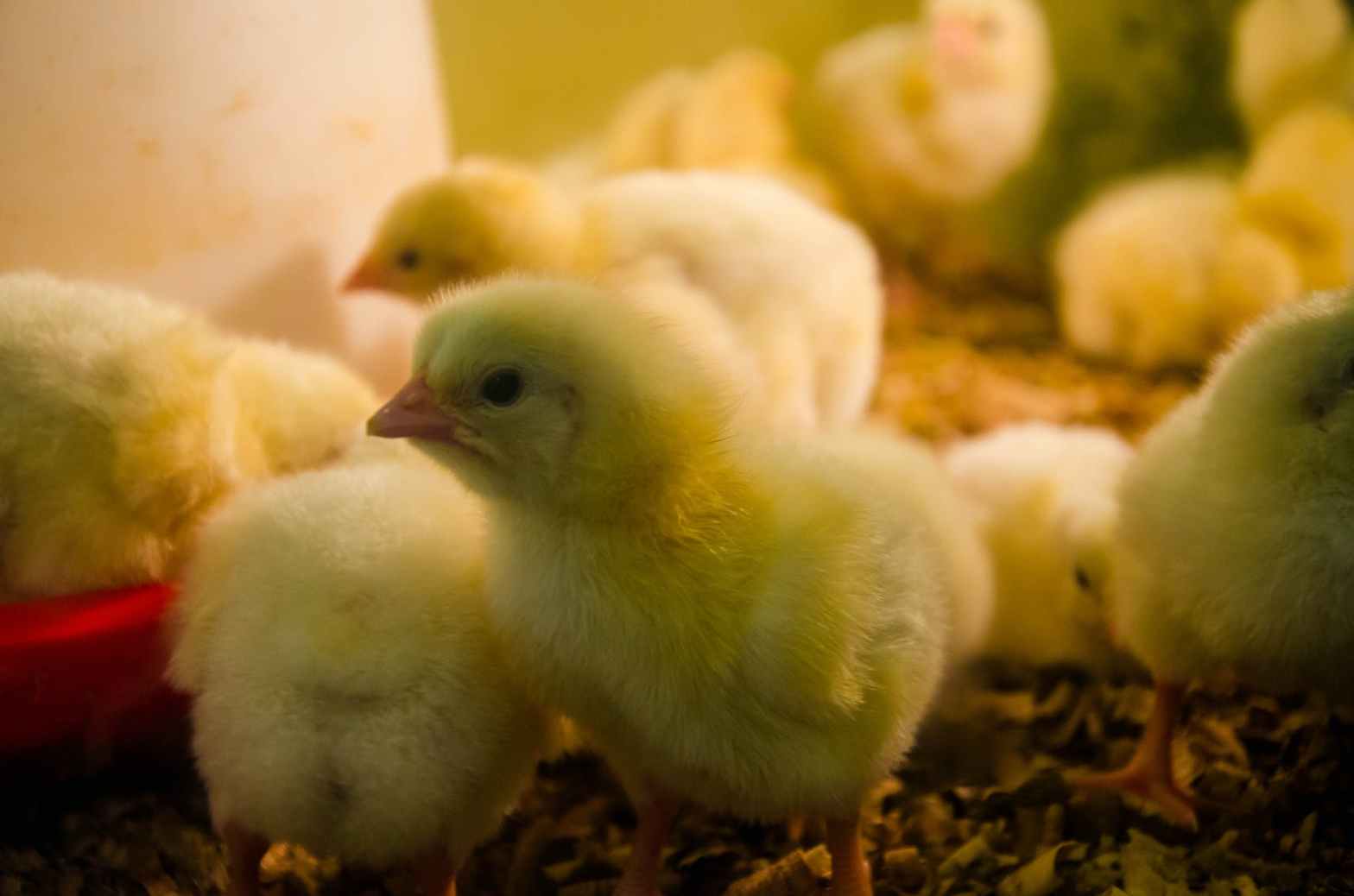
Chicken or egg: Hatchery welfare issues for female layer chicks
21 November 2021
Many consumers now consider where eggs come from; chickens in various farming systems, but less so on where these chickens came from; the hatchery. The culling at hatcheries of male chicks, considered waste product as they cannot lay eggs, has increased as a consumer welfare concern1, and rightly so. With availability of new egg sexing technology Germany and France are set to ban male culling from 2022, calling on others to follow suite2.
What has to be remembered is that male culling is not the only welfare concern at the hatchery, far from it. Research and investigations have shown female chicks endure numerous hatchery processes and the long term effects, discussed below.
In commercial egg production chicks are exposed to many potentially stressful procedures3. Fertilised eggs brought from laying units are kept in incubators, then moved to the hatcher when close to hatching. From there the chicks are emptied from the hatcher trays and travel through the processes of being sexed and sorted, much of which is automated. Females are sorted, vaccinated, beak ‘trimmed’ and transported, whereas males and injured birds are culled.
There are various animal welfare concerns, including mutilation (beak trimming), culling, injury and stress from handling and machinery including conveyer belts (including falls or becoming trapped), exposure to disinfectant (such as Formalin, a noxious substance that can cause irritation), human error and potential equipment failure causing physical suffering4.
An investigation in two UK hatcheries in 2010 captured gassing, maceration, beak trimming, handling and incidents of a chick stuck in equipment and another falling from a conveyer belt on camera5, see Figure 1.
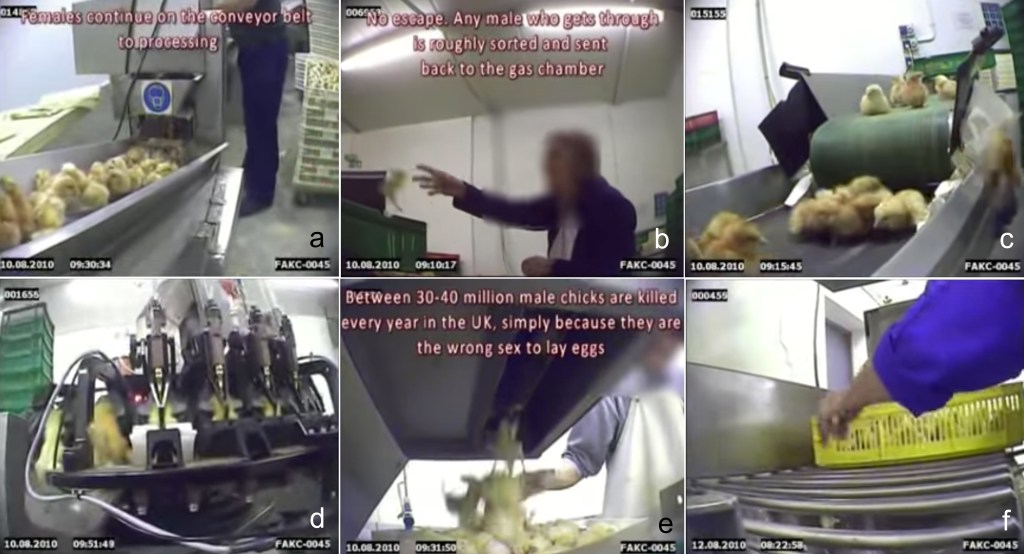
a) processing; b) chick thrown; c) chick falls from conveyer belt; d) beak trimming; e) gassed chicks; f) maceration.
Studies have shown that pain6, human handling7, noise8, temperature9 and light10 are sources of stress for chicks. Specific research into the consequences of commercial hatchery routine in laying chicks found significantly increased corticosterone blood levels (indicating stress) during and after the hatchery process, fearful behaviour and feather damage and injuries suggestive of feather pecking and aggression. The conclusion is that commercial hatchery processing is a stressful experience for chicks which has short and long-term effects on behaviour and stress reactivity.
Beaks are an important, innervated sensory tool for chickens11, 12. However, layer chicks have their beaks ‘trimmed’; a mutilation involving removing a portion of the hen’s beak at the hatchery. This is done in attempt to minimise cannibalism and pecking injuries which arise due to concentrated living conditions where an established ‘pecking order’ is impossible to maintain and stressed hens harm each other13. A farmer once claimed to an animal welfare organisation I worked for that trimming beaks is like trimming toenails; painless. It’s not; beaks have nerves. Welfare concerns over beak trimming have been raised12 which include short term pain associated with the procedure and subsequent long term chronic pain11,14, loss of sensory organ11, 14, impaired ability to feed and exhibit other behaviours11, 14, 15, and development of neuromas13.
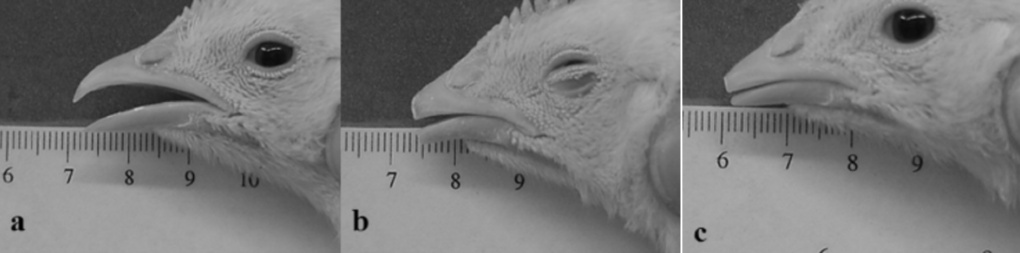
Infrared beak trimming, which involves an infrared beam directed at the beak, is the only legal method in hatcheries in England16 as opposed to hot blade trimming. See Figure 2. Infrared beak trimming is claimed to be less problematic than hot blade17, but there is evidence to suggest acute pain occurs with both infrared and hot blade beak trimming18. The pain and issues arising from beak trimming is the trade off for continued intensive egg farming. A UK ban was proposed due to welfare concerns, however it is delayed as there is no alternative14, which is a major welfare concern given the evidence and numbers; the vast majority of laying hens in the UK, including free-range, are routinely beak trimmed19.
It is not only the male chicks that are culled: sickly, deformed or injured female birds are also disposed of 4, 20. Injuries can occur throughout the hatchery process including handling, machinery, conveyer belts, beak trimming and vaccination4. Maceration or gas are the standard methods.
Maceration involves chicks entering machinery which will either ‘mince or crush’ them20. To be considered humane, mechanical equipment must cause immediate death which relies on optimally functioning machinery. However, as many acknowledge, this is not an aesthetic image for us to consider21, and indeed the UK farm industry shies away from it, stating that gas, not maceration, is used in the UK22.
Culling with high concentration carbon dioxide gas has been identified as a welfare issue as it is acidic and causes distress20. Certain inert gas mixtures including of argon are recommended4, 20, though expensive21 so prohibitive. Moreover, research into the aversion of chicks to various lethal gas mixtures found all gas mixtures, at all concentrations, were aversive to an extent23. Therefore a degree of distress at killing continues.
While the issue of male chick culling gains traction, we must remember that hatchery processes also cause female chicks to experience short and long term pain, stress, mutilation and its consequences and fearful behaviour. Free-range comerical systems are not free from cruelty. As long as commercial egg production continues hens will suffer.
References
1. Underwood, G., Andrews, D., Phung, T. & Edwards, L. (2021). Incubation, hatchery practice and the welfare of layer hens. Animal Production Science, 61 (10) 867-875.
2. McDougal, T. (2021, February 4). Germany to ban culling of day old male chicks next year. Poultry World. Retrieved from https://www.poultryworld.net/Health/Articles/2021/2/Germany-to-ban-culling-of-day-old-male-chicks-next-year-705887E/ on 14 October 2021.
3. Hedlund, L., Whittle, R. & Jensen, P. (2019). Effects of commercial hatchery processing on short and long term stress responses in laying hens. Scientific Reports, 9 (2367) 1-10. Retrieved from DOI:10.1038/s41598-019-38817-y on 15 October 2021.
4. RSPCA (2017). RSPCA welfare standards for hatcheries. Retrieved from https://science.rspca.org.uk/sciencegroup/farmanimals/standards/hatcheries on 15 October 2021.
5. Viva! Charity (2010). The fate of almost all male chicks in organic, free range, barn and caged egg farm systems. Accessed at https://www.youtube.com/watch?v=I6i2zg-dkOs on 2 November 2021.
6. Gentle, M. J. (2011). Pain issues in poultry. Applied Animal Behaviour Science, 135, 252–258.
7. Ericsson, M. & Jensen, P. (2016). Domestication and ontogeny effects on the stress response in young chickens (Gallus gallus). Scientific Reports, 6, 35818.
8. Chloupek, P., Voslářová, E., Chloupek, J., Bedáňová, I., Pištěková, V. & Večerek, V. (2009). Stress in broiler chickens due to acute noise exposure. Acta Veterinaria Brno, 78, 93-98.
9. Shinder, D., Luger, D., Rusal, M., Rzepakovsky, V., Bresler, V. & Yahav, S. (2002). Early age cold conditions in broiler chickens (Gallus domesticus): thermotolerance and growth responses. Journal of Thermal Biology, 27, 517-523.
10. Olanrewaju, H. A., Thaxton, J. P., Dozier III, W. A., Purswell, J., Roush, W. B. & Branton, S. L. (2006). A review of lighting programs for broiler production. International Journal of Poultry Science, 5 (4) 301–308.
11. Janczak, A. M. & Ribert, A. B. (2015). Review of rearing-related factors affecting the welfare of laying hens. Poultry Science, 94, 1454–1469. Retrieved from https://doi.org/10.3382/ps/pev123 on 6 October 2021.
12. Nicol, C. (2018). Feather pecking and cannibalism: Can we really stop beak trimming? In: J. A. Mench (Ed.), Advances in Poultry Welfare. (pp175-197). Woodhead Publishing. Retrieved from https://doi.org/10.1016/B978-0-08-100915-4.00009-9 on 18 October 2021.
13. Underwood, G. & Glatz, P. C. (2019). Current methods and techniques of beak trimming laying hens, welfare issues and alternative approaches. Animal Production Science, 61(10) 968-989.
14. Farm Animal Welfare Council (FAWC) (2007). Opinion of beak trimming of laying hens. Retrieved from https://edepot.wur.nl/166174 on 7 October 2021.
15. Prescott, N. B. & Bonser, R. (2004). Beak trimming reduces feeding efficiency of hens. The Journal of Applied Poultry Research, 13 (3) 468-471
16. The Mutilations (Permitted Procedures) (England) (Amendment) Regulations 2010. Accessed at: https://www.legislation.gov.uk/uksi/2010/3034/regulation/2/made on 2 November 2021.
17. Clarke, P. (2014, July 12). How infra-red beak trimming for layers works. Farmers Weekly. Retrieved from https://www.fwi.co.uk/livestock/poultry/how-infra-red-beak-trimming-for-layers-works on 2 November 2021.
18. Marchant-Forde, R. M., Fahey, A. G. & Cheng, H. W. (2008). Comparative effects of intrared and one-third hot-blade trimming on beak topography, behaviour and growth. Poultry Science, 87 (8) 1474-1483. Retrieved from DOI:10.3382/ps.2006-00360 on 17 October 2021.
19. The Beak Trimming Action Group (2015). The Beak Trimming Action Group’s review. Retrieved from https://assets.publishing.service.gov.uk/government/uploads/system/uploads/attachment_data/file/480111/Beak-Trimming-Action-Group-Review.pdf on 16 October 2021.
20. Humane Slaughter Association (2019). Code of Practice for the Disposal of Chicks in Hatcheries 3rd Edition. Retrieved from https://www.hsa.org.uk/downloads/chick-code-2019-in-layout.pdf on 16 October 2021.
21. Jongman, E. C. & Fisher, A. D. (2021). Euthanasia of laying hens: an overview. Animal Production Science, 61 (10) 1042-1047.
22. Davies, J. (2015, August 12). Animal rights group films chick maceration in French hatchery. Farmers Weekly. Retrieved from https://www.fwi.co.uk/livestock/poultry/layers/animal-rights-group-films-chick-maceration-french-hatchery on 3 November 2021.
23. Sandilands, V., Raj, A. B. M., Baker, L. & Sparks. (2011). Aversion of chickens to various lethal gas mixtures. Animal Welfare, 20 (2) 253-262.
 On Animals